

Methodology
Living Tensor's services are grounded in a methodology called Semantic Eduction that surfaces latent domain and process knowledge as a justified foundation for software development and evolution with coding agents. Practitioners examine the relevant business and technical environment across domains, including documents, data, reports, formulas, subject-matter knowledge and software where it exists. This investigation produces an eduction map connecting sources, consequential dependencies and justified interpretations to a path machines can follow. The map guides analysis and formalisation into obligations, models and specifications that support detection of design and implementation drift. The work can begin before an application exists.
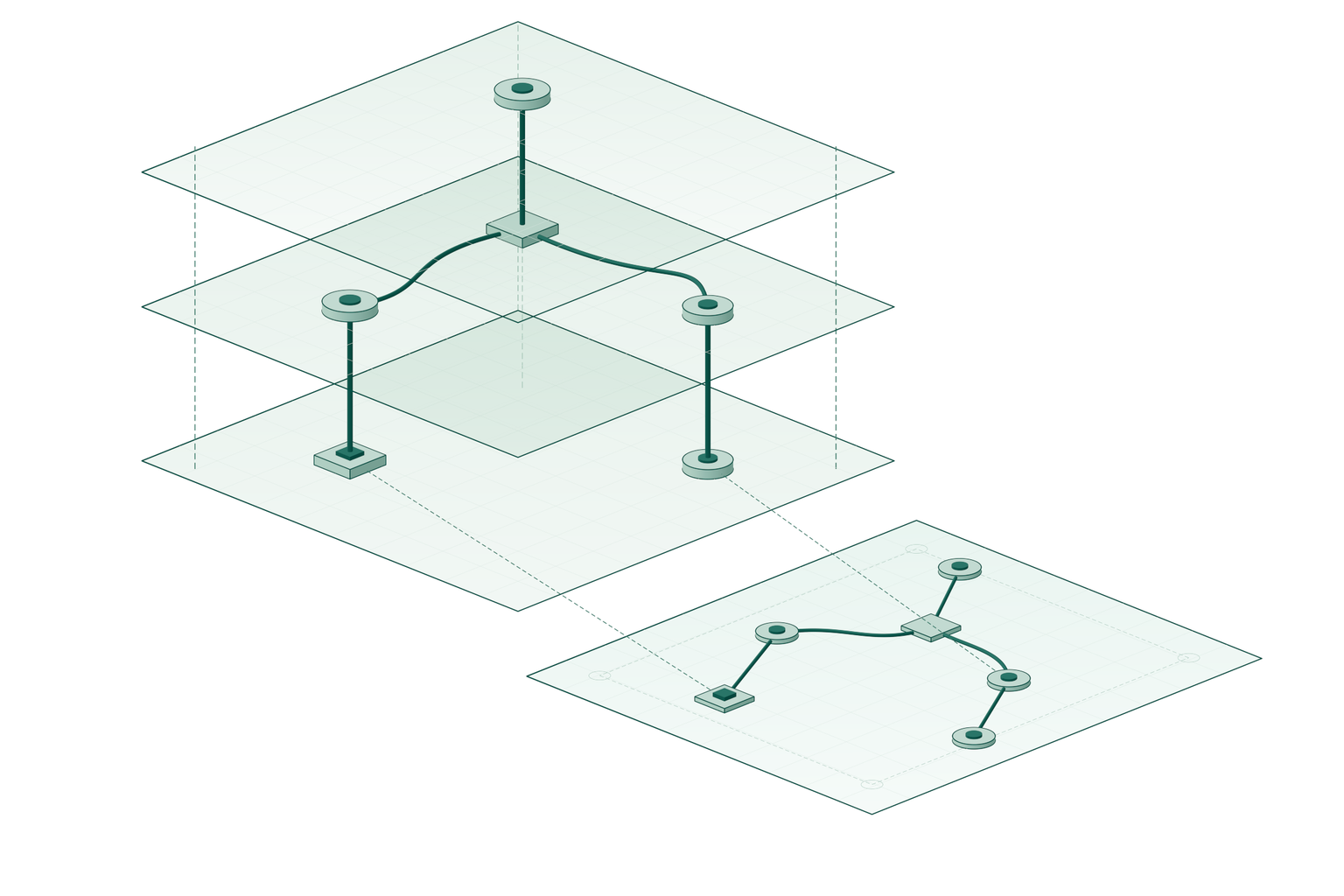
Establishing the obligations
Practitioners examine reports, worksheet formulas, data, documents and established business practices together with the knowledge of subject-matter experts. The examination follows consequential relationships across business and technical domains. In Excel-based financial operations, for example, a reported figure can depend on both formulas and adjustments understood by accountants and controllers. Source code, configuration and operating records contribute evidence where software exists.
The investigation establishes which observed rules express applicable behavioural and design obligations and which express defects or incidental choices. A recurring adjustment may implement a legitimate policy or compensate for an upstream defect; its formula alone does not establish which interpretation applies. The intended development or change establishes what the agent must realise or preserve and which decisions remain open. Ambiguities are resolved through further evidence or an authorised decision.
Grounding business and design concepts
The meaning of identities, states, events, units and timing is established from the relevant evidence. A payment instruction, its retries and its financial effects must retain their intended relationship. Design commitments identify component responsibilities, interfaces, data ownership and permitted dependencies. These concepts guide the intended representation in a new application and are connected to the actual representation when code exists.
Tracing mechanisms and assumptions
Consequential results are traced through their supporting formulas, records, decisions, manual adjustments and external commitments. Where software exists, this work also follows code, configuration, persistence, concurrency and failure paths across system boundaries. The account establishes the mechanisms and environmental assumptions on which each obligation depends, with supporting evidence and explicit limits. Essential complexity consists of distinctions and relationships needed to retain the covered obligations and capabilities; incidental structure can change without that loss. Practitioners justify this distinction through the domain and mechanism evidence.
Making semantics usable
The eduction map connects the relevant sources, meanings, mechanisms and abstractions to the analyses and representations needed to make the semantics usable. It develops through expert examination and is refined when machine analysis reveals dependencies or counterexamples. The resulting foundation includes explanatory documents, architectural accounts, models and specifications with supporting evidence. The selected form retains the distinctions, dependencies, exceptions and premises relevant to the covered obligations. Where automated assurance is required, executable specifications or other machine-checkable contracts express the obligations precisely. This foundation can guide a first implementation before target code exists. Teams retain the material in an editable form.
Guiding and checking coding-agent work
Coding agents receive the justified meaning, obligations, design commitments and assumptions for their task. Proposed designs are assessed against that foundation. The first implementation and subsequent changes are checked against the relevant behavioural and structural obligations, including affected configuration, dependencies and migrations. Each result identifies what was checked, the evidence connecting the specification to the actual software, and the assumptions and limits on which it depends.
The engineering team controls intentional changes to obligations and design commitments. An implementation task cannot silently weaken its acceptance conditions. Specifications, assumptions and implementation checks are maintained as the system evolves.
Research foundation
The whitepaper, Semantic Eduction: From Latent Knowledge to Executable Semantics for Coding Agents, sets out the methodology, supporting arguments and evidence, and the limits of its claims.
Read the whitepaper (PDF)